
Learn OpenGL in Rust: Hello Triangle
Picking up where the window left off
This is the second post in my series working through Joey de Vries' Learn OpenGL book while porting the C++ code to Rust as I go. All of the conceptual material, the pipeline explanations, and the progression belong to that book; I am just doing the translation and writing down what surprised me. This post covers the Hello Triangle chapter, which follows the Hello Window chapter I covered in the previous post. Go read the book chapter first; I am assuming you have its explanations of the graphics pipeline and will focus on the Rust side here.
The last chapter was mostly plumbing: a GLFW window, a context, and a screen
cleared to teal. This one is where the actual graphics pipeline shows up, and it
is where the Rust port stops being a one-to-one transcription. Buffers of raw
bytes get handed to the driver, shader source gets shipped across the FFI
boundary as C strings, and OpenGL's error reporting is a set of out-parameters
and a fixed-size char buffer. Each of those needs a little thought in Rust.
Vertex input and the VBO
The book starts with three vertices in normalized device coordinates. In Rust
that is a plain array of f32.
    let vertices: [f32; _] = [
        /*     x,        y,       z, */
        -0.5_f32, -0.5_f32, 0.0_f32,
         0.5_f32, -0.5_f32, 0.0_f32,
         0.0_f32,  0.5_f32, 0.0_f32,
    ];
The [f32; _] annotation is a small nicety: I get to say "this is an array of
f32" and let the compiler infer the length, which keeps me from having to
update a count every time I add a vertex. The _f32 suffixes on the literals
are the moral equivalent of the f suffix the book uses in C++.
Next we generate a buffer object and upload the data. This is the first place the FFI boundary bites.
    let mut vbo: u32 = 0;
    let mut vao: u32 = 0;
    // SAFETY: Assume the functions are dynamically loaded via the symbol lookup.
    unsafe {
        gl::GenVertexArrays(1, &mut vao);
        gl::GenBuffers(1, &mut vbo);

        gl::BindVertexArray(vao);

        gl::BindBuffer(gl::ARRAY_BUFFER, vbo);
        gl::BufferData(
            gl::ARRAY_BUFFER,
            std::mem::size_of_val(&vertices)
                .try_into()
                .expect("failed to represent usize value as an i32"),
            /*
             * TODO: Might be interesting to debug incorrect size in RenderDoc.
             *
             * vertices
             *     .len()
             *     .try_into()
             *     .expect("failed to represent usize value as an i32"),
            */
            vertices.as_ptr().cast(), /* cast *const f32 into *const c_void */
            gl::STATIC_DRAW,
        );
Three things going on here that the C++ version does not have to say out loud.
The size argument is std::mem::size_of_val(&vertices), not vertices.len().
In C++, sizeof(vertices) on a stack array gives you the byte count and there
is nothing to get wrong. In Rust, .len() on an array is the element count,
so reaching for the obvious method would hand OpenGL 9 where it wants 36. I left
the wrong version in as a comment because I think it would be genuinely
instructive to watch what
RenderDoc shows when the driver is told the buffer
is a quarter of its real size.
size_of_val returns a usize, but glBufferData wants a signed
GLsizeiptr, so every size has to go through .try_into().expect(...). C does
this conversion silently. Rust makes you acknowledge that a usize might not
fit, which is noisy for a 36 byte buffer but is the same discipline that catches
real truncation bugs elsewhere.
Finally, vertices.as_ptr().cast() turns a *const f32 into the *const
c_void the C API expects. .cast() is the tidier spelling of an as pointer
cast, and it keeps the constness for you.
Linking vertex attributes and the VAO
Telling OpenGL how to interpret those bytes is glVertexAttribPointer. The
translation is mechanical, but the last two arguments are worth pointing at.
        gl::VertexAttribPointer(
            0,
            3,
            gl::FLOAT,
            gl::FALSE,
            (3 * size_of::<f32>())
                .try_into()
                .expect("failed to represent usize value as an i32"),
            ptr::null(),
        );
        gl::EnableVertexAttribArray(0);
    }
gl::FALSE is not a Rust bool; it is OpenGL's GLboolean, a u8. And the
offset argument, which the book writes as the eyebrow-raising (void*)0, is
just ptr::null() in Rust. That is one case where the Rust version reads
better than the original: a null pointer is spelled like a null pointer
instead of a cast integer.
The stride is 3 * size_of::<f32>(), mirroring the book's 3 * sizeof(float),
and it goes through the same try_into dance as before.
Everything from gl::BindVertexArray(vao) onward is being recorded into the
VAO, which is the whole point of the object: the attribute layout and the
element buffer binding are state we would otherwise have to set up again on
every draw call.
Shaders as assets, not string literals
The book embeds GLSL in the C++ source as a raw string literal. I put mine in
assets/shader.vert and assets/shader.frag instead, mostly so my editor
treats them as GLSL.
#version 330 core
layout (location = 0) in vec3 aPos;

void main()
{
    gl_Position = vec4(aPos.x, aPos.y, aPos.z, 1.0);
}
#version 330 core
out vec4 FragColor;
void main()
{
FragColor = vec4(1.0f, 0.5f, 0.2f, 1.0f);
}Rust lets me keep them as separate files without paying for runtime file I/O.
include_str! pulls the contents into the binary at compile time, and
CString::new gives me the NUL-terminated buffer OpenGL wants.
    let vertex_shader_source = CString::new(include_str!("../assets/shader.vert"))
        .expect("string slice contains an illegal null byte internally");
CString::new can fail if the string already contains an interior NUL byte,
which is not a thing that happens in GLSL source, hence the expect. The value
of this shape is that the shader is still a real file on disk for tooling
purposes, but there is no chance of shipping a binary that cannot find its
shaders at runtime.
Compiling a shader, and the error-log dance
Compiling is the usual create/source/compile sequence.
    // SAFETY: Assume the functions are dynamically loaded via the symbol lookup.
    unsafe {
        vertex_shader = gl::CreateShader(gl::VERTEX_SHADER);
        gl::ShaderSource(
            vertex_shader,
            1,
            &vertex_shader_source.as_ptr(),
            ptr::null(),
        );
        gl::CompileShader(vertex_shader);

        gl::GetShaderiv(
            vertex_shader,
            gl::COMPILE_STATUS,
            ptr::from_mut(&mut success),
        );
        if success == 0 {
            gl::GetShaderInfoLog(
                vertex_shader,
                info_log_isize,
                ptr::null_mut(),
                info_log.as_mut_ptr(),
            );
        }
    }
glShaderSource takes an array of string pointers, so &source.as_ptr() is
doing double duty: as_ptr() gives the *const c_char, and the & makes it a
one-element array of those. ptr::from_mut(&mut success) is the explicit way to
produce the out-parameter pointer for the status i32.
The interesting part is what happens with the log buffer.
    let mut success: i32 = 0;
    let mut info_log: [i8; 512] = [0; 512];
    let info_log_isize: i32 =
        info_log.len().try_into().expect("failed to represent usize value as an i32");
if success == 0 {
// SAFETY: The i8 values in info_log can safely be represented as u8
// since the byte values represent characters.
let char_slice: &[u8; 512] = unsafe { std::mem::transmute(&info_log) };
let error_string = format!(
"ERROR::SHADER::VERTEX::COMPILATION_FAILED: {}",
match std::str::from_utf8(char_slice) {
Ok(s) => String::from(s),
Err(e) => format!("Invalid UTF-8 found in error message: {}", e),
},
).trim_end_matches("\0").trim_end().to_string();
return Err(error_string);
}In C++ this is a char infoLog[512] that gets handed straight to std::cout.
In Rust the buffer is [i8; 512] because that is what GLchar maps to on this
platform, so getting a &str out of it takes three steps: reinterpret the i8
bytes as u8, validate that they are UTF-8, and then strip the trailing NUL
padding that the driver left in the unused tail of the buffer. The transmute
is the one genuinely gross bit, though it is a safe reinterpretation here since
i8 and u8 have the same layout and we only ever read the bytes as
characters. The from_utf8 check is not just ceremony either; it means a driver
that hands back garbage produces a diagnostic instead of undefined behavior.
Notice that the error path return Err(...) rather than printing. I changed
main's signature for this chapter.
fn main() -> Result<(), String> {A failed shader compile is not a panic-worthy bug in my program, it is a message
from a compiler that lives in the graphics driver. Returning it as an Err gets
it printed to stderr with a nonzero exit status for free, and it composes if I
later factor the shader loading into its own function.
The fragment shader repeats the same three blocks with gl::FRAGMENT_SHADER and
a different error prefix. There is an obvious refactor waiting here (a
compile_shader(kind, source) -> Result<u32, String> helper), but the book
writes it out longhand and I wanted the first pass to stay close to the source
material.
Linking the shader program
Linking follows the same create/attach/link/check pattern.
    // SAFETY: Assume the functions are dynamically loaded via the symbol lookup.
    unsafe {
        shader_program = gl::CreateProgram();
        gl::AttachShader(shader_program, vertex_shader);
        gl::AttachShader(shader_program, fragment_shader);
        gl::LinkProgram(shader_program);

        gl::DeleteShader(vertex_shader);
        gl::DeleteShader(fragment_shader);

        gl::GetProgramiv(
            shader_program,
            gl::LINK_STATUS,
            ptr::from_mut(&mut success),
        );
The shader objects get deleted immediately after linking, exactly as the book
does: the program has what it needs, and the shaders are just intermediates at
that point. Note that the status query is GetProgramiv / GetProgramInfoLog
here rather than the GetShader* variants; they are different entry points for
what looks like the same operation, and mixing them up is a classic way to get a
silently empty log.
Drawing
The render loop from the last chapter grows three lines.
        // SAFETY: Assume the functions are dynamically loaded via the symbol lookup.
        unsafe {
            gl::ClearColor(0.2_f32, 0.3_f32, 0.3_f32, 1.0_f32);
            gl::Clear(gl::COLOR_BUFFER_BIT);
            gl::UseProgram(shader_program);
            gl::BindVertexArray(vao);
            gl::DrawArrays(gl::TRIANGLES, 0, 3);
        }
Select the program, bind the VAO that describes the vertex layout, and draw three vertices as triangles. Nothing Rust-specific to say about this one, which is a good sign.
The objects Drop cannot clean up
The pleasant surprise of the last chapter was that glfwTerminate was
unnecessary because the Glfw value implements Drop. That does not extend
to OpenGL objects, and it is worth being clear about why.
    // SAFETY: Assume the functions are dynamically loaded via the symbol lookup.
    unsafe {
        gl::DeleteVertexArrays(1, &vao);
        gl::DeleteBuffers(1, &vbo);
        gl::DeleteProgram(shader_program);
    }
A VAO, a VBO, and a shader program are all just u32 handles on the Rust side.
The actual resources live in driver memory, and a bare u32 has no destructor
and no idea it means anything. Rust's ownership model buys us nothing here for
free; the cleanup is as manual as it is in C++. The natural fix is to wrap each
handle in a newtype whose Drop calls the matching gl::Delete*, which would
recover the RAII behavior. I have deliberately not done that yet, because the
book keeps the raw handles for several more chapters and I want the diffs
against the original to stay legible. It is on the list.
The result
Putting all of that together gives us the triangle the chapter is named for.
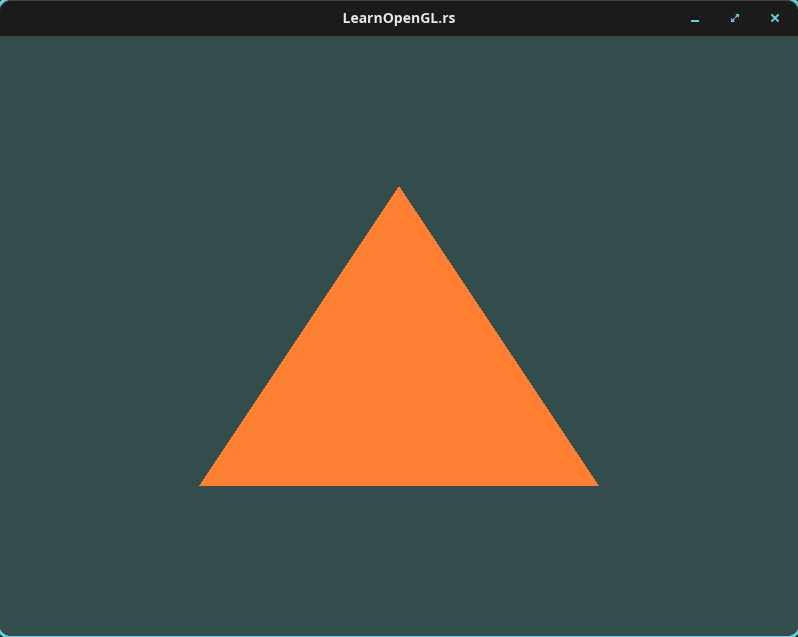
That is the orange from the fragment shader, on the teal we set up last time. The state of the project at this point is this commit (or browse the full tree at that commit). To run it yourself:
git clone https://github.com/Binary-Eater/learn-opengl.rs.git
cd learn-opengl.rs
git checkout 68057c3494408aa6ed948e95de59b192ef206600
cargo run
Every stage below is a separate commit in the same repository, so you can swap
the hash in that git checkout to reproduce any of the pictures that follow.
Element buffer objects and the rectangle
The last section of the chapter draws a rectangle out of two triangles, and uses it to motivate element buffer objects. Drawing a rectangle from two independent triangles means six vertices, two of which are exact duplicates. An EBO lets us store four unique vertices plus a list of indices into them.
I kept the wasteful version around as a comment for contrast.
    /*
     * A world without element buffer objects for drawing a rectangle.
     *
     * let vertices: [f32; _] = [
     *     /*     x,        y,       z, */
     *     // first triangle
     *      0.5_f32,  0.5_f32, 0.0_f32,  // top right
     *      0.5_f32, -0.5_f32, 0.0_f32,  // bottom right
     *     -0.5_f32,  0.5_f32, 0.0_f32,  // top left
     *     // second triangle
     *      0.5_f32, -0.5_f32, 0.0_f32,  // bottom right
     *     -0.5_f32, -0.5_f32, 0.0_f32,  // bottom left
     *     -0.5_f32,  0.5_f32, 0.0_f32,  // top left
     * ];
     */

    let vertices: [f32; _] = [
        /*     x,        y,       z, */
        // first triangle
         0.5_f32,  0.5_f32, 0.0_f32,  // top right
         0.5_f32, -0.5_f32, 0.0_f32,  // bottom right
        -0.5_f32, -0.5_f32, 0.0_f32,  // bottom left
        -0.5_f32,  0.5_f32, 0.0_f32,  // top left
    ];
    let indices: [u32; _] = [
        /* NOTE: indices start from 0 and end at 3 */
        0, 1, 3,   // first triangle
        1, 2, 3,   // second triangle
    ];
The index buffer is uploaded the same way the vertex buffer was, just with
gl::ELEMENT_ARRAY_BUFFER as the target.
        gl::BindBuffer(gl::ELEMENT_ARRAY_BUFFER, ebo);
        gl::BufferData(
            gl::ELEMENT_ARRAY_BUFFER,
            std::mem::size_of_val(&indices)
                .try_into()
                .expect("failed to represent usize value as an i32"),
            indices.as_ptr().cast(), /* cast *const f32 into *const c_void */
            gl::STATIC_DRAW,
        );
And the draw call becomes glDrawElements.
            gl::UseProgram(shader_program);
            gl::BindVertexArray(vao);
            /*
             * Can use polygon mode to help with debugging using wireframes
             *
             * wireframe mode: gl::PolygonMode(gl::FRONT_AND_BACK, gl::LINE);
             * default:        gl::PolygonMode(gl::FRONT_AND_BACK, gl::FILL);
             */
            /*
             * ebo is bounded to vao since the vao tracks the last EBO object
             * bound while vao is bound.
             */
            gl::DrawElements(gl::TRIANGLES, 6, gl::UNSIGNED_INT, ptr::null());
            gl::BindVertexArray(0);
The comment about the EBO being captured by the VAO is the piece of state
tracking I most wanted written down. We never bind the EBO in the render loop,
yet DrawElements finds it, because the VAO remembered the last
ELEMENT_ARRAY_BUFFER binding made while that VAO was bound. This is also why
the book warns you not to unbind the EBO while the VAO is still bound. Note the
final argument is ptr::null() again, standing in for the book's 0 offset
into the bound index buffer.
The result is a rectangle, from four vertices and six indices.
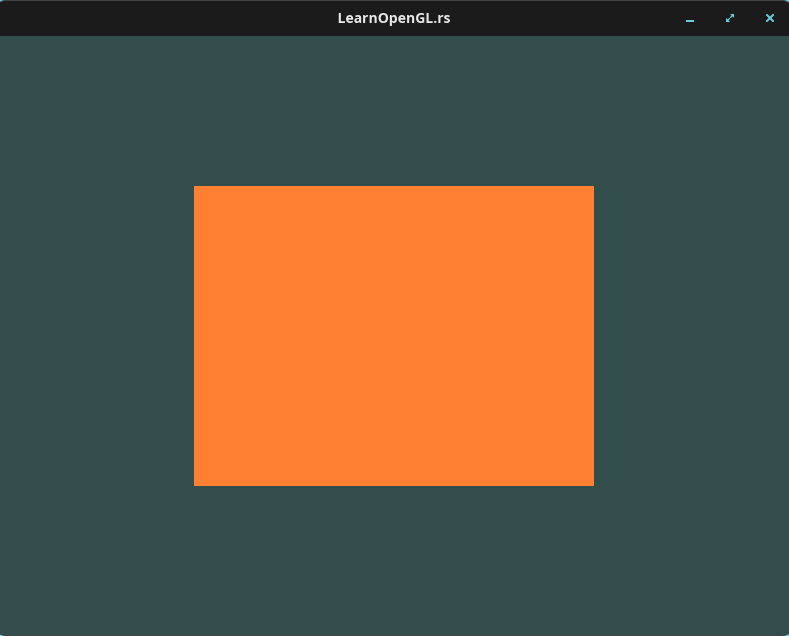
git checkout 5d75001d8ea9da2a43af16460bd84ef8a3baae22
cargo run
One bookkeeping note if you go browsing the history: I reverted this commit
right afterwards. The exercises all build on the plain single-triangle program
rather than on the rectangle, so reverting back to the 68057c3 state kept each
exercise a small, readable diff instead of a rewrite. The rectangle commit is
still in the history and still checks out and runs; it is just not an ancestor
of the exercise commits.
Exercise 1: two triangles from one buffer
Try to draw 2 triangles next to each other using
glDrawArraysby adding more vertices to your data.
This one is nearly free, which is the point of the exercise: more vertices in the same buffer, and a larger count in the draw call.
    let vertices: [f32; _] = [
        /*     x,        y,       z, */
        // left triangle
        -1.0_f32, -0.5_f32, 0.0_f32,
         0.0_f32, -0.5_f32, 0.0_f32,
        -0.5_f32,  0.5_f32, 0.0_f32,
        // right triangle
         0.0_f32, -0.5_f32, 0.0_f32,
         0.5_f32,  0.5_f32, 0.0_f32,
         1.0_f32, -0.5_f32, 0.0_f32,
]; gl::DrawArrays(gl::TRIANGLES, 0, 6);The [f32; _] inference earns its keep here; adding three vertices required no
other edit to the declaration. The only real change is the vertex count going
from 3 to 6, and size_of_val picks up the new buffer size on its own.
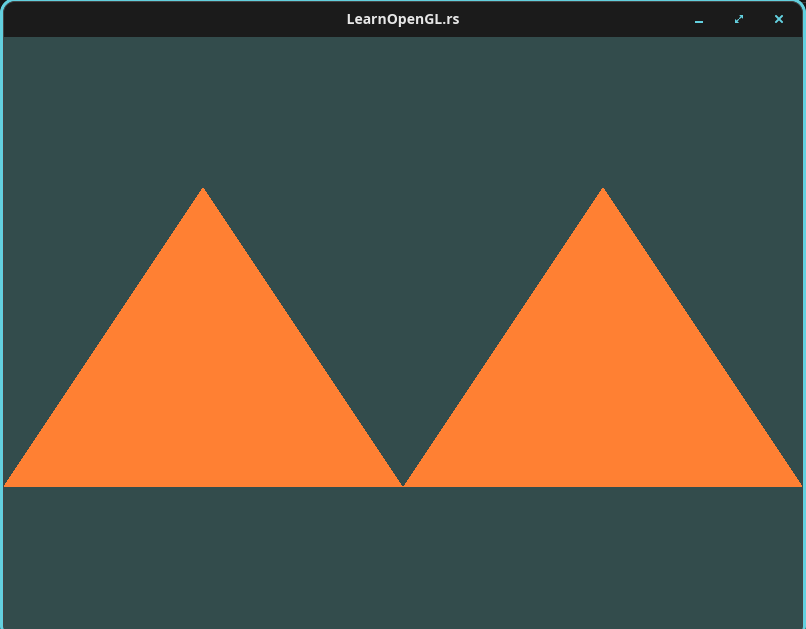
git checkout dc2e1e547e3d10b4deba4b7b4d98938956048467
cargo run
Exercise 2: two triangles from two VAOs
Now create the same 2 triangles using two different VAOs and VBOs for their data.
Same picture, different plumbing. The single vertices array splits in two, and
so does every object that referenced it.
    let left_triangle_vertices: [f32; _] = [
        /*     x,        y,       z, */
        -1.0_f32, -0.5_f32, 0.0_f32,
         0.0_f32, -0.5_f32, 0.0_f32,
        -0.5_f32,  0.5_f32, 0.0_f32,
    ];
    let right_triangle_vertices: [f32; _] = [
        /*     x,        y,       z, */
         0.0_f32, -0.5_f32, 0.0_f32,
         0.5_f32,  0.5_f32, 0.0_f32,
         1.0_f32, -0.5_f32, 0.0_f32,
    ];

    /* NOTE: could use an array of VBOs and VAOs for a single Gen* call */
    let mut left_triangle_vbo: u32 = 0;
    let mut left_triangle_vao: u32 = 0;
    let mut right_triangle_vbo: u32 = 0;
    let mut right_triangle_vao: u32 = 0;
The setup block then runs the bind/upload/attrib sequence twice, once per VAO, and the render loop draws each in turn.
            gl::UseProgram(shader_program);
            gl::BindVertexArray(left_triangle_vao);
            gl::DrawArrays(gl::TRIANGLES, 0, 3);
            gl::BindVertexArray(right_triangle_vao);
            gl::DrawArrays(gl::TRIANGLES, 0, 3);
Binding a different VAO swaps out the entire attribute configuration, which is
exactly the payoff the book advertises for VAOs. The Gen* calls all take a
count and an out-pointer, so as the note in the code says, two u32 variables
could just as well be a [u32; 2] with a single gl::GenVertexArrays(2,
arr.as_mut_ptr()). I kept them as named variables because
left_triangle_vao reads better than vaos[0], and there are only two.
The rendered output is pixel-identical to exercise 1, which is the correct answer.
git checkout 72fbec45e73b288a136f4b1388d9d2c4d9ee24a2
cargo run
Exercise 3: two shader programs
Create two shader programs where the second program uses a different fragment shader that outputs the color yellow; draw both triangles again where one outputs the color yellow.
A second fragment shader in assets/yellow_shader.frag:
#version 330 core
out vec4 FragColor;

void main()
{
    FragColor = vec4(1.0f, 1.0f, 0.0f, 1.0f);
}
It gets compiled with the same block as the first fragment shader, then linked into its own program that reuses the same vertex shader object.
    // SAFETY: Assume the functions are dynamically loaded via the symbol lookup.
    unsafe {
        yellow_shader_program = gl::CreateProgram();
        gl::AttachShader(yellow_shader_program, vertex_shader);
        gl::AttachShader(yellow_shader_program, yellow_fragment_shader);
        gl::LinkProgram(yellow_shader_program);

        gl::DeleteShader(vertex_shader);
        gl::DeleteShader(yellow_fragment_shader);
That shared vertex shader forced the one non-obvious change in this exercise.
The first program's link block used to delete both of its shaders right after
linking; now the gl::DeleteShader(vertex_shader) has to move down to after
the second program links, because deleting it too early would pull it out from
under the program still waiting to be built. The error paths shift accordingly,
so a failure partway through cleans up whichever shader objects are still
outstanding. This is manual lifetime management with no compiler helping, which
is a nice concrete example of what those Drop wrappers I keep postponing would
actually buy.
Drawing is then a matter of switching programs between the two draw calls.
            gl::UseProgram(shader_program);
            gl::BindVertexArray(left_triangle_vao);
            gl::DrawArrays(gl::TRIANGLES, 0, 3);
            gl::UseProgram(yellow_shader_program);
            gl::BindVertexArray(right_triangle_vao);
            gl::DrawArrays(gl::TRIANGLES, 0, 3);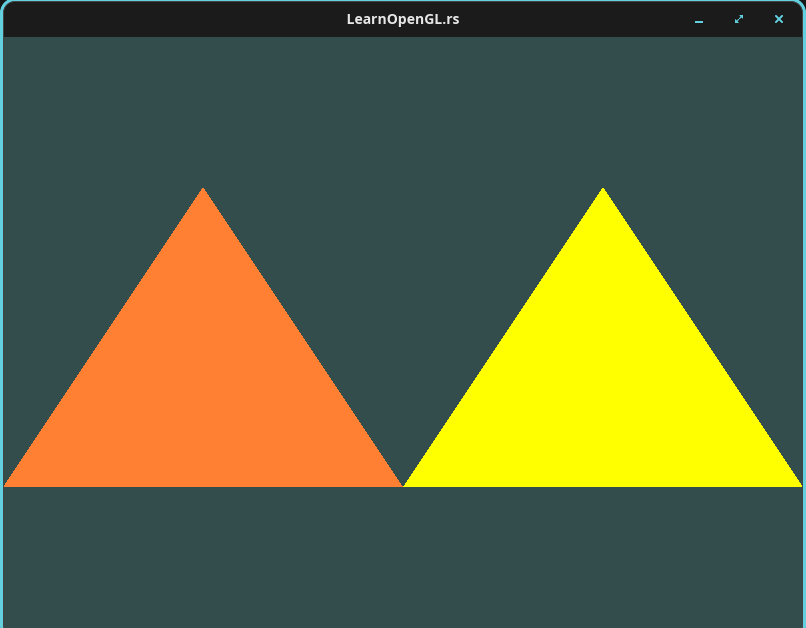
git checkout c34d22c7ba1eb5ef636f76647a66570ab0d517ab
cargo run
What's next
The thing this chapter makes obvious is how much of main is now shader
boilerplate: three near-identical compile-and-check blocks and two
link-and-check blocks, all of them managing raw handles by hand. Conveniently,
the next chapter is Shaders,
where the book builds a shader class to hide exactly that. That should be the
first place the Rust port really diverges in structure rather than just in
syntax, since a Shader type with a Drop impl and a Result returning
constructor is a much better fit than a C++ class with a cout in its
constructor. I will cover it in the next post.
As always, all the conceptual credit here belongs to Joey de Vries and the Learn OpenGL book, specifically the Hello Triangle chapter. Go support it.